
Hemifacial Microsomia (and Goldenhar Variant)
Contents
Overview
Up until fairly recently, this condition was called first and second branchial arch syndrome; even today, it sometime referred to by geneticists as oculoauriculovertebral syndrome. Hemifacial microsomia is thought to occur somewhere between 1:3,5000 and 1:5,000 births. The term craniofacial microsomia is sometimes used to describe individuals who also have involvement of the upper face and forehead.
At the current time, no specific gene has been identified that causes this condition, and it is very rare for someone with hemifacial microsomia to pass the trait on to his or her children. The exact cause of this condition remains unknown but there is some experimental evidence published many years ago suggested that if a small blood vessel ruptures near the developing ear in mice, before they are born, after birth they appear to have hemifacial microsomia. More likely, this condition results from an impaired flow of cells (called neural crest cells), which arise next to the spinal cord, and migrate to the face to form the facial skeleton; if not enough of these cells are able to successfully migrate to their intended location, that side of the face ends up being smaller.
Physical Traits
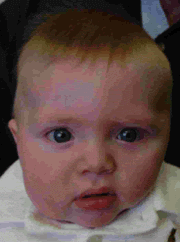

Children with hemifacial microsomia have a smaller face on the side that is affected. Parents usually note that the corner of the mouth is higher on this side and that the chin does not exactly line up in the middle of the face. The lower jaw (mandible) is flatter and shorter, and the ear is either smaller or not formed at all (microtia). The jaw joint (TMJ) may be small or even completely absent. Some children will have a cleft extending off the side of the mouth (called macrostomia), making the mouth opening larger. Some children will have weakness of the muscles on the affected side of the face. The child’s right side is more likely to be affected than the left (2:1), and up to 25% of cases are bilateral (Bifacial Microsomia). Some children are very mildly affected, and others are significantly affected. Intelligence and development are normal.
If a child has a bump, or benign tumor of the eyeball, called an “epibulbar dermoid”, then your child may have Goldenhar variant, which may be considered another type of hemifacial microsomia. Children with Goldenhar frequently have fusions of some of the vertebrae (spine) in the neck; however, this almost never requires any treatment.
Craniofacial microsomia is the term given to children with hemifacial microsomia who also have involvement of the upper face and forehead. Typically, the forehead is smaller and is not as far forward that the opposite side. The bones around the eye are usually further back, as well.
Treatment
The best treatment plan for a child with hemifacial microsomia depends upon the severity of the condition. Some children, who are the most mildly affected, might not need any treatment at all; whereas severely affected children require more care. At the current time, there is some controversy among craniofacial surgeons as to what is exactly the best treatment for children with hemifacial microsomia (or craniofacial microsomia, or Goldenhar variant).
Some doctors believe that treatment should begin at an earlier age, and others believe it is best to wait until more growth has occurred. Some doctors recommend distraction (placement of a metallic screw driven device used to lengthen bones) and others believe this device should not be used (see publications, Book Chapters, #1). The following reflects a personal approach to treating this condition. Various surgeons will recommend different techniques; hopefully this review will enable parents to ask their doctors better questions to helping parents make the best decisions for their child.
This section will first cover non-surgical treatment early treatment, then touch upon ear reconstruction, then finally give an overview of jaw surgery.
Early Non-Surgical Treatment
Ears
If a child is born with an absent ear, which is called “microtia”, then keeping the opposite functional eardrum healthy takes on an even greater importance. I recommend that parents who have a child with microtia to be on the lookout for any sign of an ear infection on the opposite side (it is not really possible to get an ear infection on the microtic side). Multiple ear infections on the unaffected side may diminish hearing; therefore, parents should have a low threshold for bringing their baby to the pediatrician (or pediatric ENT) to check for possible ear infections.
In general, the vast majority of children with microtia never need any hearing aids. It is important to have your child’s hearing tested periodically. If both the ears are normal in size, but one side (or both) is prominent (sticks out), this condition may be treated non-surgically with molding wax, as long as treatment is begun in the first few weeks of life. After about 8 weeks of age, molding does not work because the ear cartilage attains “memory.” See the ear reconstruction section for more information on ear reconstruction, or go to the Microtia Section.
Sleep apnea
It is also important to make sure that any child with hemifacial microsomia does not have sleep apnea. Children born with an absent TMJ (temporomandibular joint, or jaw joint) may have a “floppy” lower jaw that can shift backwards when the child is asleep at night, causing sleep apnea. If your child is a “noisy breather” at night, it is a good idea to get a sleep study to ensure your child is getting enough oxygen while asleep in order to continue to develop and learn normally. For some children, it is possible to use a special orthodontic device (a “Herbst appliance”) to help prevent sleep apnea. Rarely, children may need to use a special mask (called CPAP or BiPAP units) while sleeping, which helps the child to get enough oxygen while sleeping. In general, sleep apnea is not common in hemifacial microsomia, but it is important to check for in children who are more severely affected.
Speech Evaluation
Some children with hemifacial microsomia may have an imbalance in the movement of the palate (roof of mouth), which on rare occasions may lead to abnormal speech. If any asymmetrical palatal motion is identified, then your child should be evaluated by a speech pathologist.
Ear Reconstruction
For children with an absent ear (microtia), there are two options to rebuild the ear, one is to get an artificial ear, and the other is to rebuild the ear using the child’s own rib (also called an autogenous reconstruction). I believe that it is important that the child participate in the decision as to which to ear would be best. The pro and cons of each method of reconstruction are discussed in an office visit. For those families choosing an autogenous reconstruction the outer ear is typically reconstructed around age eight, but on occasion may be done as early as six. The best time to rebuild the ear is determined by the child’s size (more importantly, how big the child’s ribs are) and how the child is coping socially. Ears are reconstructed over a series of three operations.


The first stage ear reconstruction, in a child with hemifacial microsomia is shown above. Cartilage is taken from the child’s rib (parents cannot donate their rib cartilage) and this cartilage is carved and assembled to match the opposite ear. It is then inserted under the skin. Two additional stages are required to complete the reconstruction; both performed as outpatient procedures. Before undergoing ear reconstruction, it is wise to ask your doctor to see examples of his or her work. It is very difficult to rebuild an ear that did not turn out well the first time. For more detailed information on ear reconstruction, see the Microtia section.
It is also possible for children to undergo reconstruction (by a specialized ENT) of the absent eardrum in order to try to improve hearing on the affected side, and achieve some stereo hearing that improves the localization of sound. The decision as to whether or not to proceed with inner ear reconstruction should be made with a specialist in this area.
The Jaws
There are two basic approaches to centering and balancing the face. Currently, the most commonly recommended technique is to use distraction. I typically do not recommend the distraction technique at my center for a number of reasons which are listed below. The distraction technique involves making an osteotomy (cut in the bone) across the mandible (lower jaw) and attaching a metallic screw driven device to either side of this osteotomy. Pins are usually put through the skin into the bone, and the expansion device is attached to these pins. By turning a screw on the expansion device, a little each day, the bone slowly gets longer. There are also devices that are completely buried under the skin, except for a small metal bar, which pokes outside so that the screw can be turned. These distraction devices have been proven to successfully lengthen bone, and many doctors treating hemifacial microsomia recommend them. However, these devices are never used at the Craniofacial Center in Dallas for treating children affected on just one side, and only vary rarely for bilateral cases. There is a long list of reasons why I chose not to use these distraction devices:
- The overall complication rate for using these devices is about 1 out of 3 cases, as published in a survey of doctors. The complication rate was over 50% for doctors who had done fewer than 10 patients! Surveys typically underestimate complication rates, so that the actual complication rate may even be higher.
- These devices leave scars on the child’s face that cannot be removed, and remain for a lifetime. Many doctors say that the scars will fade away and not be noticeable. I recommend seeing another child’s scars first (in person, scars tend to not show up in photographs) before allowing this procedure to be done. There is an internal distraction device that does not leave facial scars, but this device has an even higher complication rate than the external device.
- The lower jaw may be lengthened in one direction with distraction, but distraction cannot widen the face. So, after distraction is done, the chin will line up nicely in the center of the face, but the side of the face will be even flatter. I believe that the use of distraction causes more children to require adding additional soft tissue to the face to help balance it. Rebuilding the facial skeleton (described below) reduces the need for additional operations to build up the soft tissues of the face.
- The teeth usually fit together fairly normally before using a distracter. However, after distraction, with one side of the lower jaw longer, the teeth will not line up with the other teeth. The result is that extensive orthodontia will be required, and eventually surgery may be needed to correct this problem.
- In order to attach the distracter to the jaw, it is necessary to use metal pins or screws. It is very likely that the front pins or screws will go through the child’s un-erupted permanent teeth. The result is that the permanent tooth will not come up and the child will need an artificial tooth (or multiple artificial teeth).
- The upper jaw is not treated by distraction. This means that after the two operations are finished, one to put on the distracter and one to take it off, the upper jaw is still too small on the affected side, and will frequently need surgery to correct it.
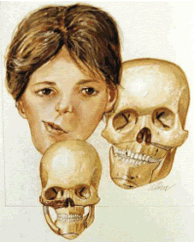
The alternative to the use of distraction is a single-staged orthognathic procedure. From inside the mouth (so there are no scars on the face except for a short scar just in front of the ear) the upper and lower jaws may be cut and moved into a better position and, if necessary, an absent TMJ can be rebuilt using the child’s own rib. It is best to delay this surgery until the child is older and wants to have the surgery done. This operation is longer and more complicated than putting on a distracter, and not every doctor is able to do this procedure; but the final result is that both jaws are aligned in the middle of the face in just one operation.
This single-staged operation is not a “perfect” operation. There is a possibility for an infection afterwards (about 10% chance) that may require a small operation to treat. If this operation is done at a very young age, there is a good chance that it may need to be repeated when the face is finished growing sometime around 16 to 18-years old. Overall, weighing all the positives and negatives, the single-staged correction is the best treatment, at the lowest risk.
Treatment Summary
I believe it is best to be conservative when it comes to recommending surgery. Most children with hemifacial microsomia are fairly mildly affected, which means that while their faces are flatter on one side, and the chin may not line up perfectly in the middle, they overall look just fine. For these children, I prefer to wait until they are ready to proceed with surgery and then to choose the smallest possible operation that will bring about the biggest change. Sometimes, only a small outpatient procedure to line up the chin is all that is necessary. In general, the fewer major operations that are done, the better the child ends up looking as an adult. It is important to discuss the specifics of any proposed operation with your craniofacial surgeon to make sure that you understand what is being done and why.